
ConBatt® · Structural Energy Storage
Structural Energy Storage
Turning infrastructure into energy infrastructure.
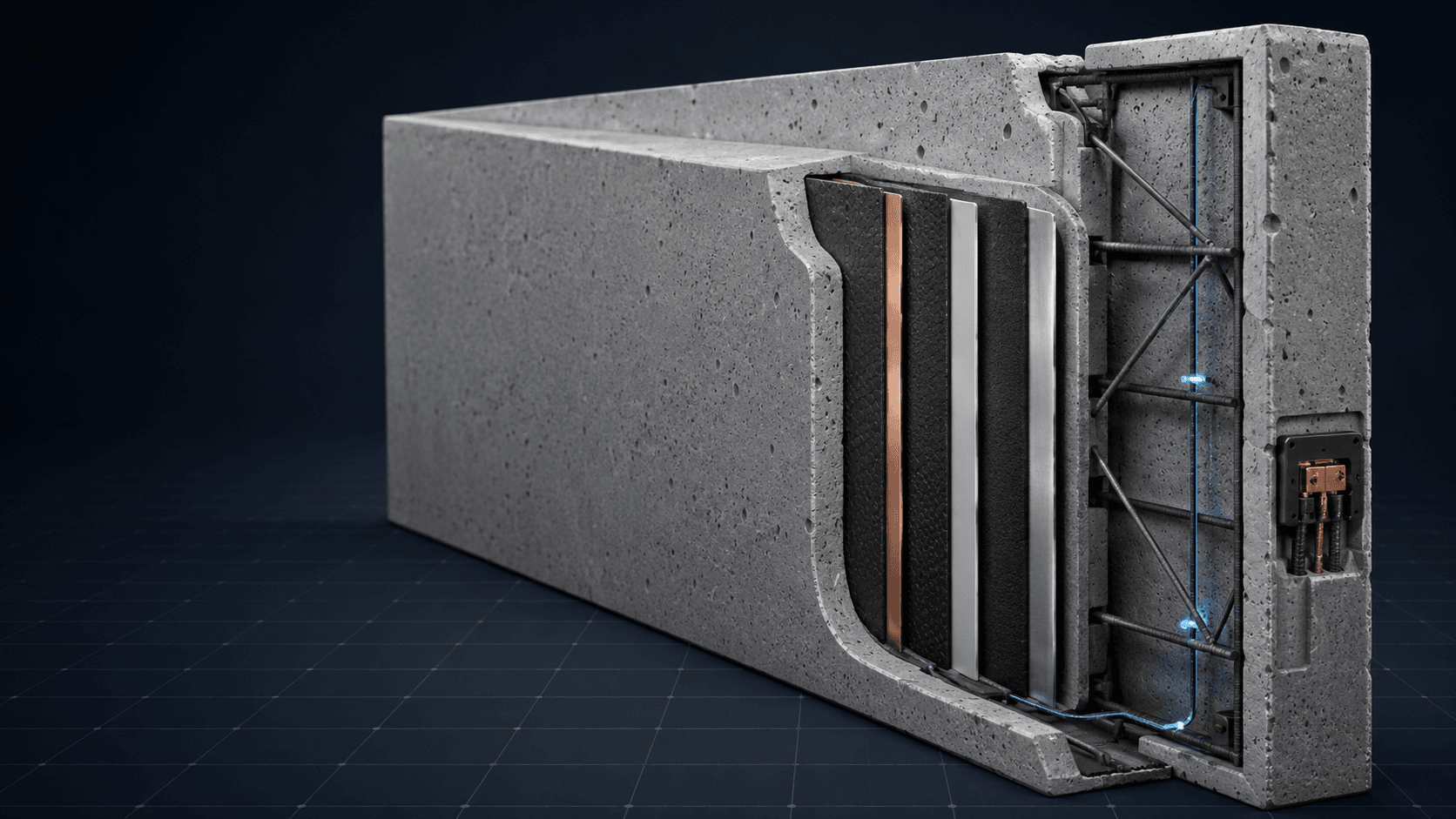
ConBatt is MEP World Group's advanced structural energy-storage platform — an emerging technology designed to integrate electrochemical energy storage into concrete blocks, panels, barriers, walls, foundations, and other built assets.
Instead of adding a conventional battery system beside a structure, ConBatt is being developed to make the structure itself part of the energy-storage system.
Built around MEP's graphene materials capabilities, advanced electrode architecture, solid-state electrolyte development, and SeaMix® concrete technology, ConBatt is intended to create durable, space-efficient energy storage for critical infrastructure, defense, transportation, data centers, microgrids, and resilient construction.
Development-stage platform — performance specifications will be published as validated.
The Proposition
Infrastructure That Does More
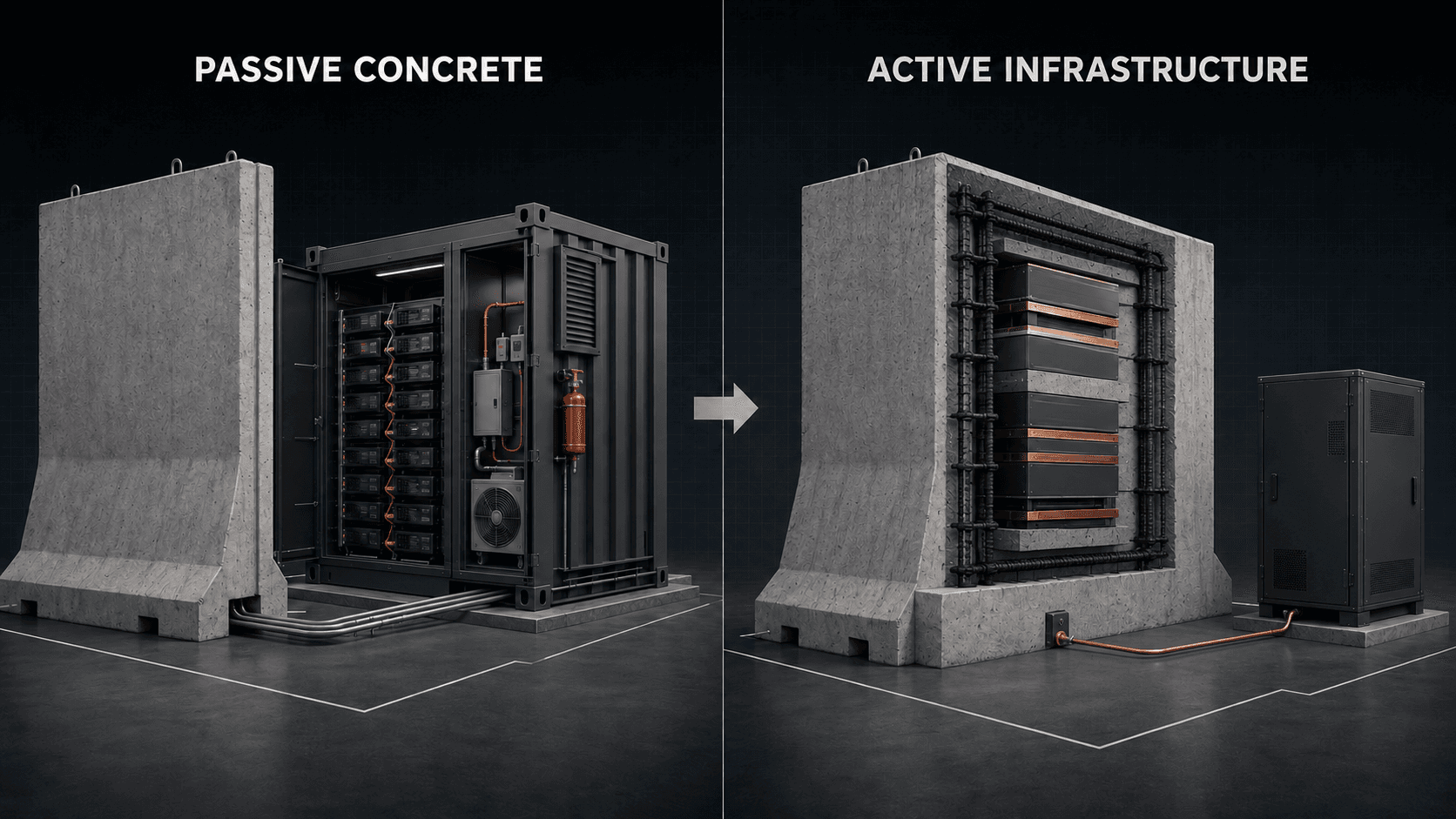
Conventional stationary batteries require dedicated space, structural support, enclosures, thermal-management systems, fire-protection measures, and separate installation infrastructure. Those requirements add cost and complexity while consuming space that could otherwise serve the mission of the facility.
ConBatt is being engineered around a fundamentally different proposition:
Replace selected passive concrete components with structural elements capable of storing and supplying energy.
The ConBatt architecture is designed to combine graphene-enhanced electrodes, a solid or ceramic-filled electrolyte, embedded current collection, intelligent monitoring, and a high-performance cementitious matrix into modular structural components — providing both physical and electrical utility from the same installed footprint.
The Platform
The ConBatt Platform
ConBatt brings together several complementary MEP World Group capabilities.
Graphene-Enhanced Electrodes
Graphene is being evaluated as a conductive and reinforcing material within the electrode architecture. The development program includes silicon-graphene anodes and multiple potential cathode chemistries selected according to performance, safety, cost, domestic availability, and application requirements.
Solid-State Battery Architecture
ConBatt is being developed around solid or ceramic-filled electrolyte systems rather than conventional flammable liquid-electrolyte packaging. The objective is to improve stability, localize failures, and create an electrochemical system suitable for integration within a mineral-based structural matrix.
SeaMix® Structural Matrix
MEP's SeaMix® technology provides a graphene- and basalt-enhanced cementitious platform designed for demanding environments — improved crack control, durability, material resilience, and compatibility with brackish, reclaimed, and saltwater formulations where properly engineered. Within ConBatt, the matrix is intended to protect and support the embedded energy-storage architecture.
Modular Power & Monitoring
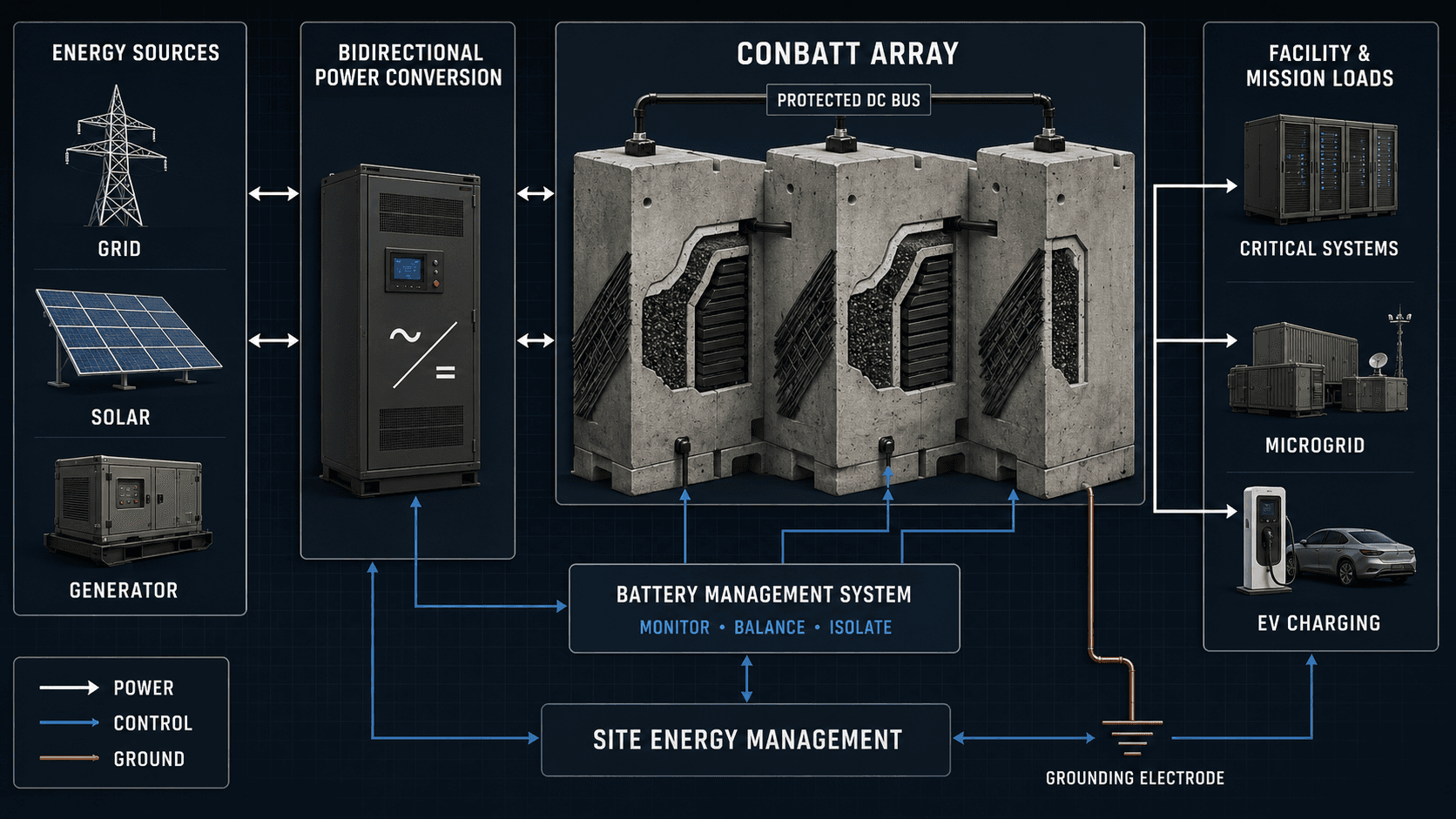
Embedded electrical connections and sensing points are intended to let individual ConBatt elements interconnect into larger storage arrays. Future configurations may incorporate battery-management functions, state-of-charge and state-of-health monitoring, cell isolation, power conversion, and integration with site energy-management systems.
Design Concept
How ConBatt Is Designed to Work
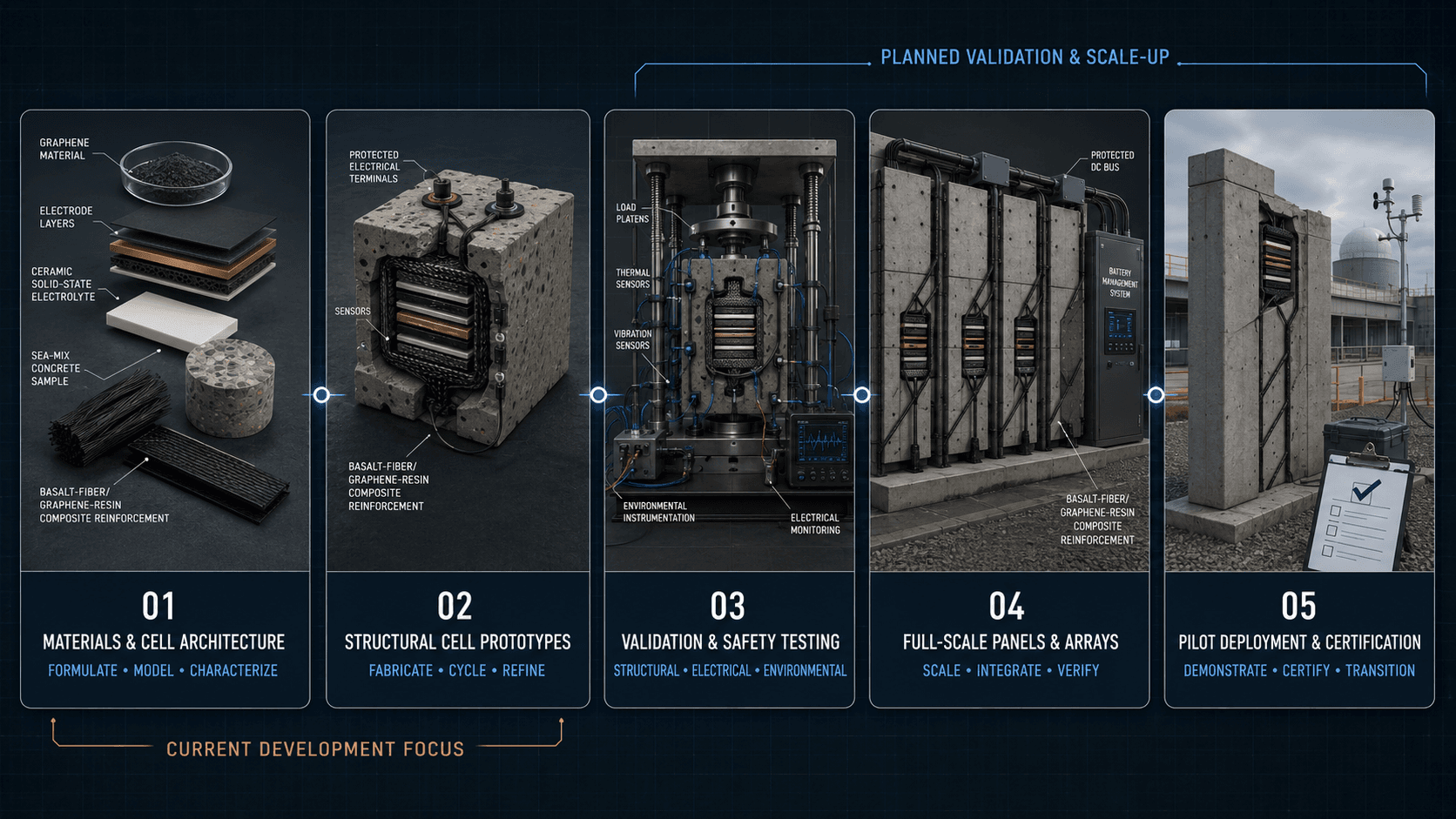
The envisioned production process integrates battery fabrication with established precast and modular construction practices.
- 1
Graphene-enhanced active materials are formulated into electrode coatings.
- 2
Electrode layers, current collectors, and the solid-state electrolyte are assembled into a protected energy-storage core.
- 3
The core is positioned within a block, panel, barrier, or other structural form.
- 4
SeaMix® or another application-specific structural formulation is cast around the protected core.
- 5
Embedded electrical connections, sensors, and isolation systems allow the component to be tested and integrated into a larger energy system.
- 6
Finished components are installed as structural or protective assets and connected to a battery-management and power-conversion system.
The manufacturing concept is being designed for compatibility with precast facilities, distributed production, and eventual licensing to qualified manufacturing and infrastructure partners.
Applications
One Platform. Multiple Mission Environments.
Defense & Expeditionary Infrastructure
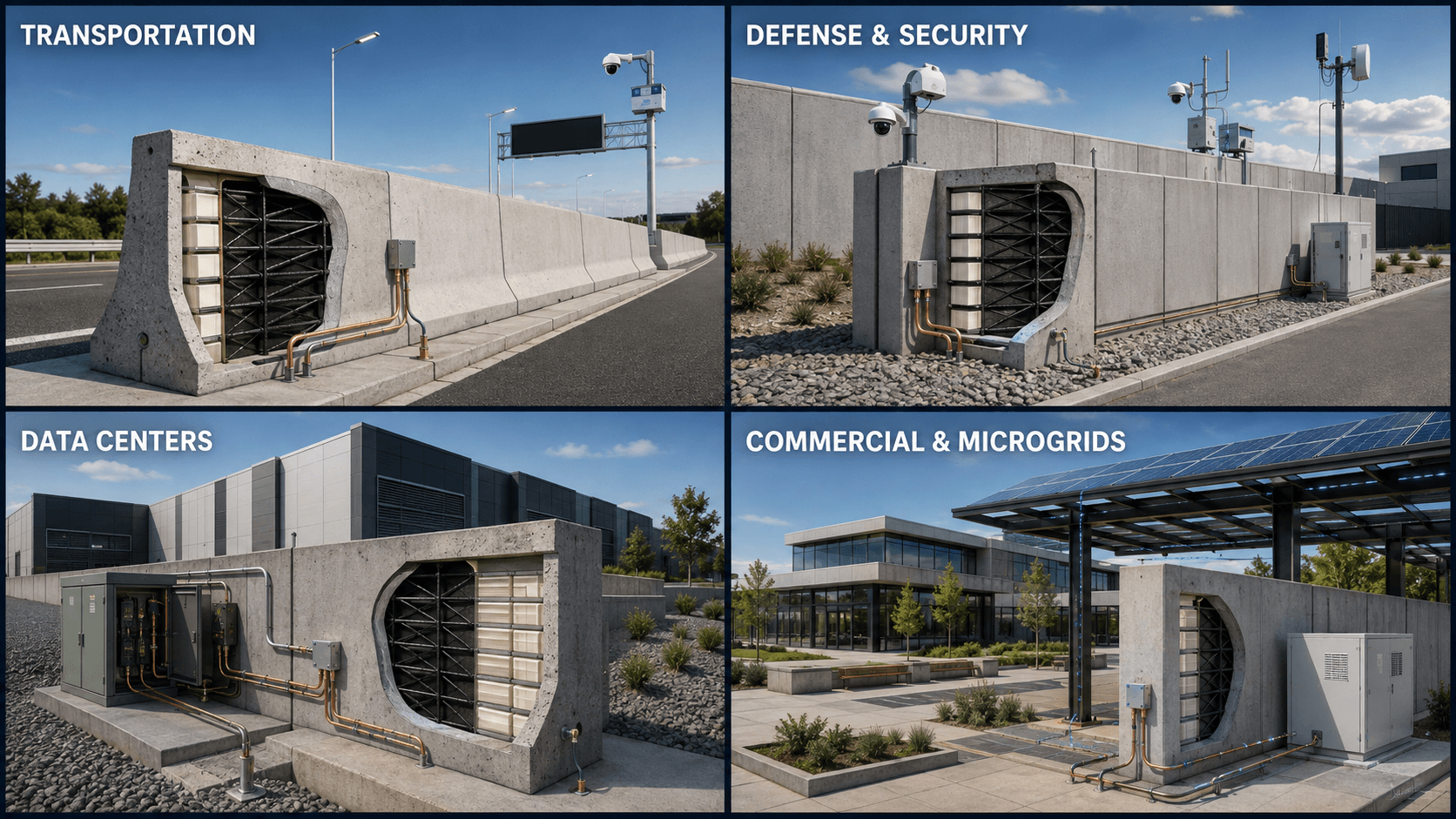
ConBatt could enable walls, barriers, revetments, shelters, and perimeter systems to provide silent energy for sensors, communications, lighting, surveillance equipment, and local microgrids.
- Forward operating base barriers
- Expeditionary shelters
- Perimeter security systems
- Hardened command facilities
- Sensor and communications power
- Rapidly deployable microgrid components
- Energy-resilient secure facilities
By combining protective mass with energy storage, ConBatt may reduce separately transported battery equipment and decrease dependence on generator fuel in austere environments.
Critical Facilities & Data Centers
Data centers, command centers, communications facilities, hospitals, and other critical sites require significant backup and power-conditioning capacity. Conventional battery rooms consume valuable space and add cooling, containment, and fire-protection requirements.
- Foundations and structural walls
- Exterior and security barriers
- Modular equipment enclosures
- Campus microgrids
- Peak-load buffering systems
- Renewable-energy storage
- Emergency and black-start support
The long-term objective is to add distributed storage without an equivalent increase in dedicated battery-building footprint.
Transportation Infrastructure
Transportation agencies already deploy enormous quantities of concrete in barriers, sound walls, bridge components, stations, sidewalks, and roadside structures.
- Roadway lighting
- Traffic sensors and communications
- Emergency signage
- Intelligent transportation systems
- Grid-edge energy buffering
- Solar and other distributed generation
- EV-charging infrastructure
- Wireless-charging corridors
A modular precast format could let ConBatt components match established transportation footprints and installation practices while adding a new energy function.
Commercial & Municipal Construction
ConBatt could give developers and public agencies a new way to incorporate distributed storage into buildings and public infrastructure without sacrificing as much usable space.
- Parking structures
- Municipal buildings
- Emergency-response facilities
- Schools and community shelters
- Industrial campuses
- Renewable-energy developments
- Resilient housing
- Smart-city infrastructure
Remote & Distributed Energy
Where land, logistics, water quality, or electrical infrastructure are constrained, ConBatt could combine locally useful structural components with distributed storage.
- Agricultural energy systems
- Remote communications
- Solar installations
- Disaster-response infrastructure
- Island facilities
- Resilient community microgrids
Why ConBatt
Intended Advantages
ConBatt is being developed to pursue several advantages over separately installed battery systems.
Dual-Purpose Infrastructure
The same installed element is intended to provide structural, protective, or architectural value while also contributing energy-storage capacity.
Reduced Dedicated Footprint
Embedding storage within infrastructure could reduce the need for separate battery rooms, racks, containers, and support structures.
Safety by Architecture
A solid-state electrolyte, modular cell isolation, and a nonflammable concrete matrix are intended to limit heat propagation and localize damage — subject to formal abuse testing and certification.
Thermal & Environmental Protection
The surrounding structural matrix may provide thermal mass and protection against impact, vibration, weather, and moisture when properly designed for the operating environment.
Distributed Resilience
Rather than concentrating storage in one enclosure, ConBatt could distribute capacity across a facility, corridor, or perimeter, isolating a damaged element while unaffected components remain available.
Domestic & Distributed Manufacturing
Developed for production through existing precast and modular ecosystems, with a materials strategy of bio-derived carbon feedstocks, domestic production, and reduced dependence on foreign-controlled supply chains.
Application-Specific Chemistry
Not limited to a single cathode chemistry — NMC, LFP, manganese-rich, and others may be evaluated for the energy density, critical-material, safety, service-life, and cost needs of each application.
Development & Validation
A Transparent Development Pathway
ConBatt is an advanced development platform moving through material characterization, architecture refinement, prototype fabrication, and validation planning — evaluating electrochemical and structural performance simultaneously. Development is currently focused on stages 01–02, with validation and scale-up planned ahead.
The Validation Framework
The program evaluates ConBatt across four domains simultaneously. Test methods and acceptance criteria are defined by application.
Energy Performance
- Capacity & energy density
- Power & rate capability
- Efficiency & impedance
- Cycle & calendar life
Structural Performance
- Compressive strength
- Flexural response
- Crack propagation
- Performance under load
Environmental Durability
- Temperature extremes
- Freeze-thaw exposure
- Moisture & salt fog
- Vibration & shock
Safety & System Integration
- Thermal & fault response
- Module isolation
- BMS & sensor operation
- Grounding & power interface
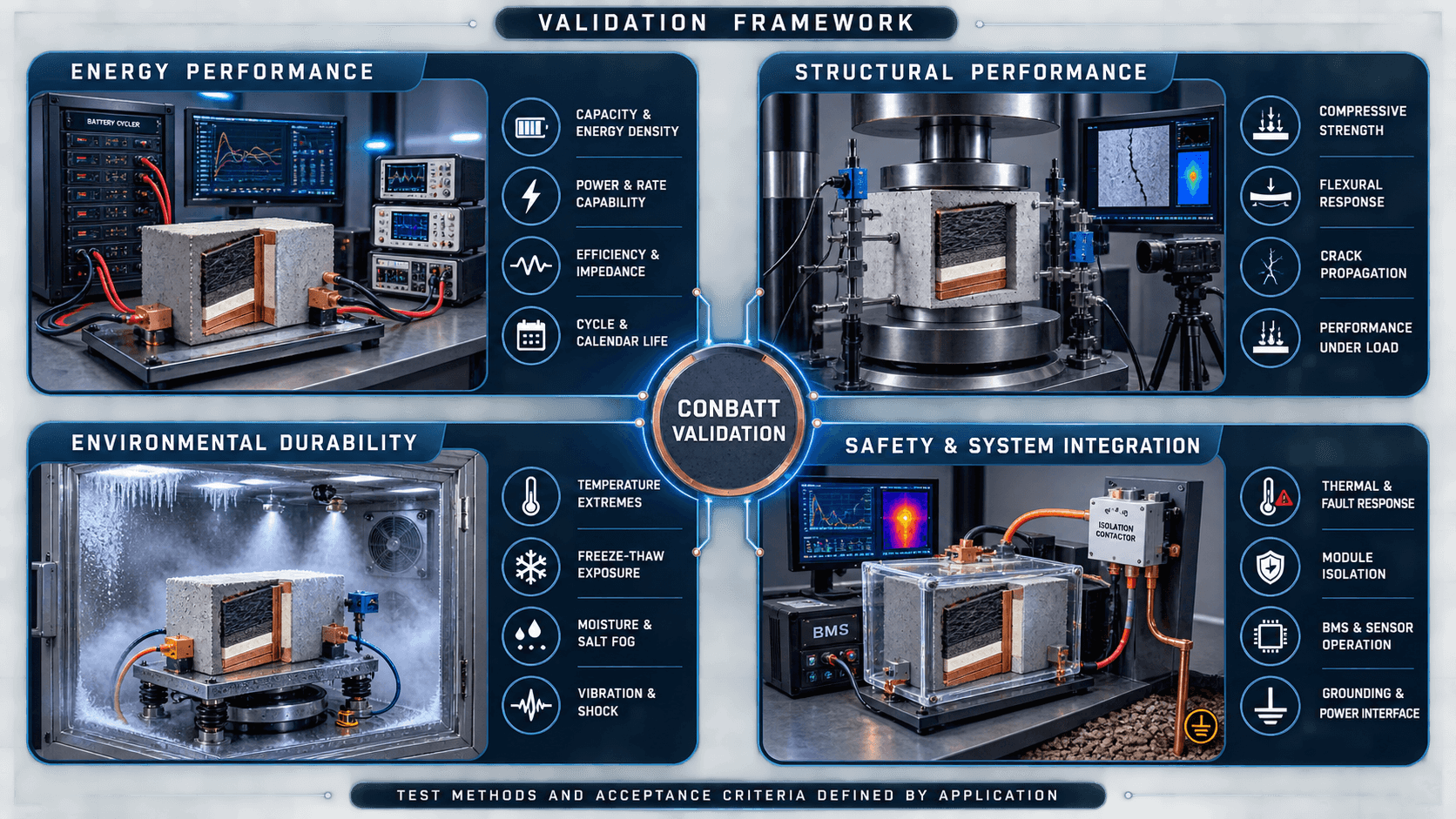
The validation pathway is expected to include relevant ASTM structural testing, electrochemical characterization, environmental testing, fault and abuse testing, manufacturing quality controls, and applicable UL, NFPA, IEC, and transportation requirements. Performance specifications will be published as they are demonstrated through controlled testing and, where appropriate, independent third-party validation.
Current R&D
Development Objectives
- Producing repeatable laboratory-scale structural cells
- Preserving electrochemical performance during casting and curing
- Maintaining structural integrity during charge and discharge cycling
- Optimizing graphene loading and electrode composition
- Selecting appropriate solid-state electrolyte and cathode chemistries
- Developing embedded sensing and battery-management controls
- Demonstrating safe, localized response to electrical or physical damage
- Scaling from test coupons to blocks, panels, and multi-element arrays
- Establishing repeatable manufacturing quality controls
- Validating performance in representative operating environments
- Preparing the technology for pilot installations and certification
Collaborate
Partner With MEP World Group
ConBatt creates opportunities across materials science, battery engineering, precast manufacturing, construction, defense, transportation, energy management, and critical infrastructure. We are seeking qualified partners for:
- Application definition and feasibility analysis
- Material and electrochemical research
- Prototype fabrication
- Laboratory and independent testing
- Precast manufacturing development
- Power electronics and battery-management integration
- Government and commercial pilot deployments
- Infrastructure engineering
- Licensing and regional manufacturing
Organizations evaluating a specific ConBatt use case can work with MEP to define the structural function, required storage capacity, operating environment, integration requirements, applicable standards, and validation pathway.
What if the infrastructure you already need could also store the energy you depend on?
Talk with MEP World Group about a ConBatt research partnership, application study, or pilot deployment.